
Pay-Per-Click advertising can either become your fastest growth engine or your biggest money drain. The difference? Understanding the right metrics. Many business owners run ads but fail to interpret performance data correctly, leading to wasted budgets and missed opportunities.
If you want to scale profitably, you need clarity—not just clicks and impressions, but what those numbers actually mean for your business growth. In this guide, we’ll break down the PPC Metrics Every Business Owner Must Understand, explained in simple, actionable terms.
This is not theory. These are real-world metrics used by performance marketers to optimize campaigns, reduce costs, and maximize ROI.
Table of Contents
- What Are PPC Metrics?
- Most Important PPC Metrics Explained
- How to Track PPC Metrics Effectively
- Mini Case Study: Turning Loss into Profit
- Common PPC Mistakes to Avoid
- Expert Tips for Better PPC Performance
- FAQs
What Are PPC Metrics?
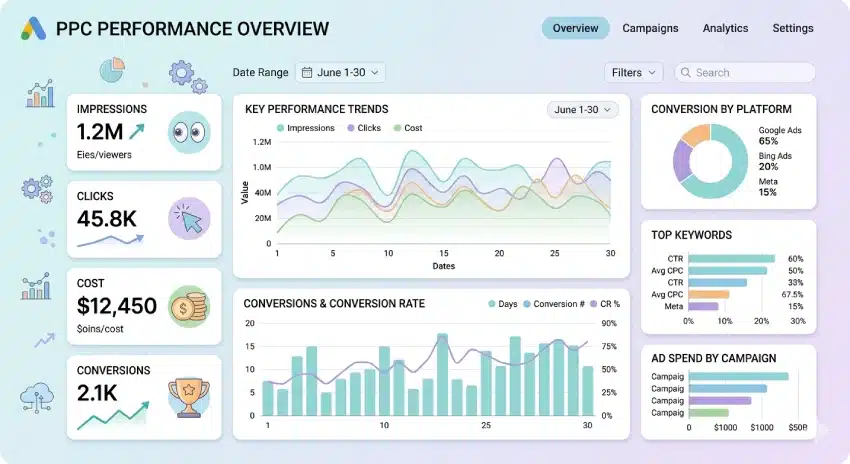
PPC metrics are measurable data points that show how your paid advertising campaigns are performing. These include clicks, conversions, costs, and engagement indicators that help you understand whether your ads are generating profit or wasting money.
Without tracking PPC KPIs, you’re essentially running blind. Metrics help you make data-driven decisions instead of guessing what works.
Most Important PPC Metrics Explained
Let’s break down the core PPC performance metrics every business owner must understand:
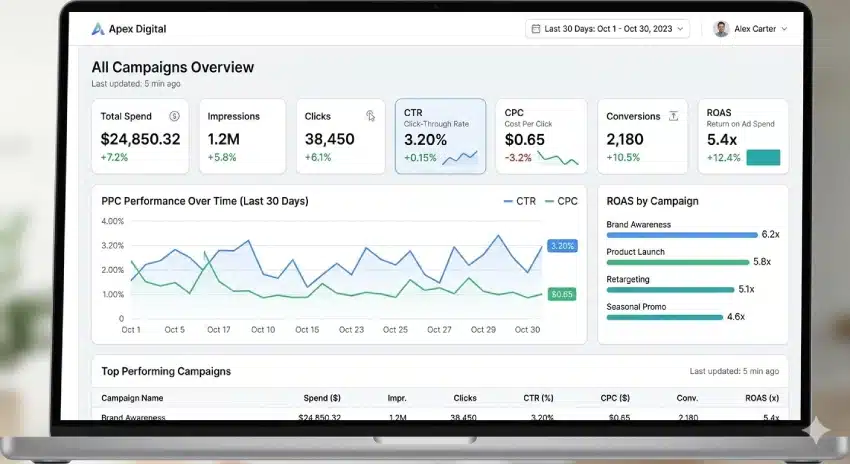
1. Click-Through Rate (CTR)
Definition: CTR is the percentage of users who click your ad after seeing it.
- Formula: (Clicks ÷ Impressions) × 100
- Indicates ad relevance and attractiveness
Quick Insight: A low CTR means your ad copy or targeting is weak.
Improving CTR often involves better headlines, clearer messaging, and stronger emotional triggers.
2. Cost Per Click (CPC)
Definition: CPC is the amount you pay each time someone clicks your ad.
This is one of the most critical Google Ads metrics because it directly impacts your budget.
- Lower CPC = More traffic for the same budget
- Higher CPC = Competitive keywords or poor optimization
To reduce CPC, businesses often combine SEO strategies with paid campaigns for better efficiency.
3. Conversion Rate (CR)
Definition: The percentage of visitors who complete a desired action (purchase, signup, etc.).
Direct Answer: Conversion rate shows how effectively your landing page turns clicks into customers.
If your conversion rate is low, the problem is rarely the ad—it’s usually the landing page or offer.
Improving CR often involves better UX, faster loading speed, and persuasive content, which you can achieve through professional web development services.
4. Cost Per Conversion (CPA)
Definition: The cost required to acquire one customer.
- Formula: Total Spend ÷ Conversions
This metric determines whether your campaign is profitable or not.
Key Insight: If your CPA is higher than your profit margin, you’re losing money.
5. Return on Ad Spend (ROAS)
Definition: Revenue generated for every dollar spent on ads.
Direct Answer: ROAS = Revenue ÷ Ad Spend
This is the ultimate metric for business owners.
- ROAS of 4:1 means you earn $4 for every $1 spent
If you’re serious about scaling, focus on improving ROAS instead of just increasing traffic.
6. Impression Share
This shows how often your ads appear compared to total possible impressions.
Low impression share means:
- Budget limitations
- Poor ad ranking
Optimizing this helps dominate your market visibility.
7. Quality Score
Google assigns a score (1–10) based on:
- Ad relevance
- Landing page quality
- Expected CTR
Higher quality score = Lower CPC + Better placements
Learn more from Google Ads official guide.
How to Track PPC Metrics Effectively
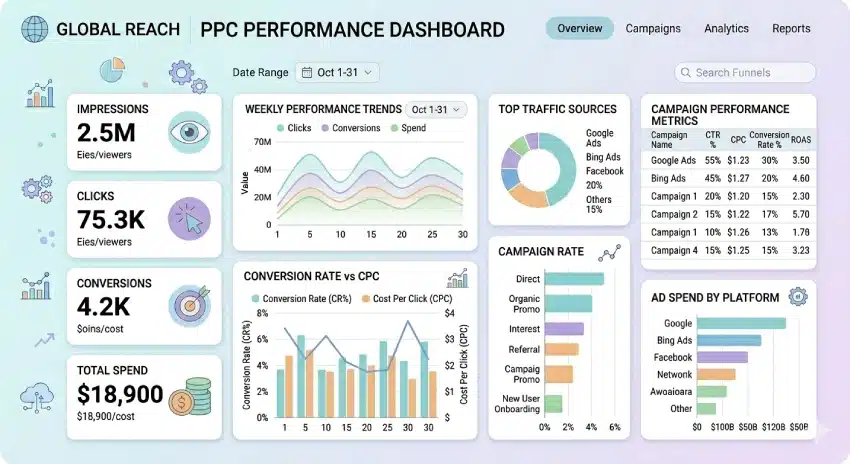
Tracking PPC metrics correctly is just as important as understanding them.
Step-by-Step Tracking Process
- Set up Google Ads conversion tracking
- Connect Google Analytics
- Define clear goals (sales, leads, calls)
- Use UTM parameters for accuracy
- Monitor weekly performance reports
For businesses looking to streamline tracking, professional PPC management services can ensure accurate data and optimization.
Mini Case Study: Turning Loss into Profit
A small eCommerce business was spending ₹50,000/month on ads but struggling with low returns.
Initial Metrics:
- CTR: 1.2%
- CPC: ₹25
- Conversion Rate: 0.8%
- ROAS: 1.5
After optimizing:
- Improved ad copy → CTR increased to 3.5%
- Landing page redesign → Conversion rate jumped to 2.8%
- Keyword refinement → CPC reduced to ₹18
Final ROAS: 4.2
The business became profitable without increasing budget—just by focusing on the right PPC KPIs.
Common PPC Mistakes to Avoid
- Focusing only on clicks, not conversions
- Ignoring landing page experience
- Not tracking conversions properly
- Targeting broad keywords without intent
- Failing to optimize campaigns regularly
Many businesses also neglect ongoing improvements, which is why investing in website maintenance is crucial for sustained performance.
Expert Tips for Better PPC Performance
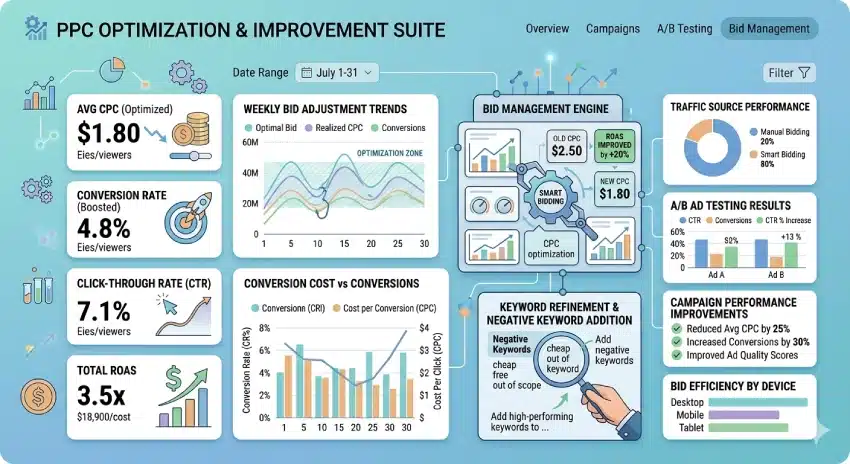
Want to outperform competitors? These insights make the difference:
- Focus on intent-driven keywords instead of high-volume ones
- Test multiple ad variations continuously
- Optimize landing pages first before scaling ads
- Use remarketing to recover lost visitors
- Integrate social media campaigns via social media management
Also, combining PPC with Google My Business optimization can dramatically improve local conversions.
Why Understanding PPC Metrics Matters for Growth
If you’re investing money into ads, understanding PPC performance metrics is not optional—it’s essential.
These numbers tell a story:
- Where your money is going
- What’s working
- What needs fixing
Business owners who master these metrics gain a competitive edge, make smarter decisions, and scale faster.
If you’re unsure where to start, you can always contact our experts or learn more about our approach.
Frequently Asked Questions
What are the most important PPC metrics for beginners?
The most important PPC metrics every business owner must understand include CTR, CPC, conversion rate, CPA, and ROAS. These provide a complete view of performance and profitability.
How can I improve my PPC conversion rate?
You can improve conversion rate by optimizing your landing page, improving ad relevance, and targeting high-intent keywords. A strong offer also plays a major role.
What is a good ROAS for PPC campaigns?
A good ROAS depends on your business model, but generally, a 3:1 or 4:1 ratio is considered healthy for most industries.
Why is my PPC campaign not profitable?
Common reasons include high CPC, low conversion rates, poor targeting, or weak landing pages. Analyzing key PPC KPIs helps identify the issue.
Ready to Maximize Your PPC ROI?
Understanding metrics is just the beginning. The real growth happens when you act on them.
If you want campaigns that generate real revenue—not just traffic—our team at ZestyClicks can help you build, optimize, and scale profitable PPC campaigns.
👉 Take the next step today: Explore our services or get in touch now.